Welcome to Barts!

May 7, 2009  posted by Admin


Welcome to Barts Tree Service – Tree, Stone, and Stump Grinding services.


 Quality Work, Quick Response, Reasonable Rates


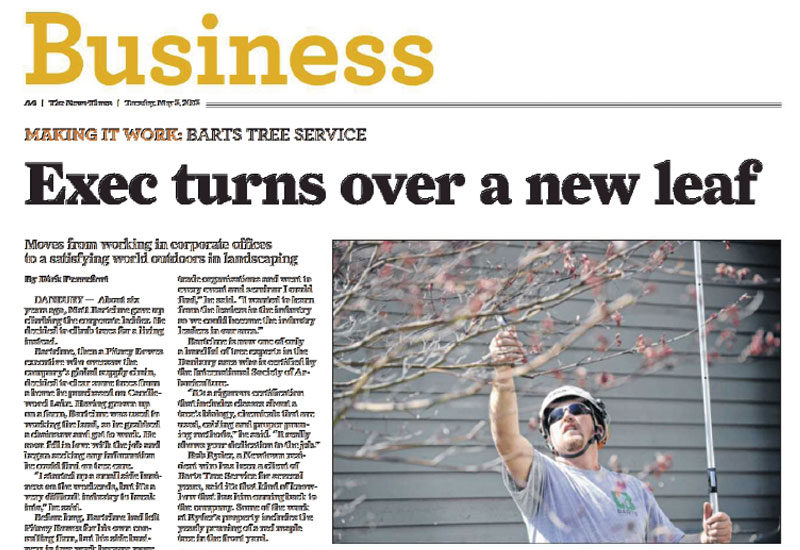
Barts Tree Service is family owned and operated out of Danbury Connecticut. Our service area includes Fairfield county, Westchester county, southern Litchfield county and north western New Haven county.


Our goal at Bart’s is to develop standing relationships with our clients that exceed customer expectations while keeping safety and service foremost. This approach combined with our trademark thorough cleanup and attention to detail leaves each job site looking better than we found it.


Our services include:

  • Tree removal
  • Stump grinding
  • Lot clearing
  • Pruning
  • Landscaping
  • View enhancement
  • Storm damage cleanup
  • Insurance claim quotes
  • Large & hazardous removals
  • Stone walls
  • Patios
  • Unilock
  • Stone facing
  • Retaining walls
  • Firewood

Barts Tree Service is fully insured and licensed (# 0625619)


We are also a  member of the Greater Danbury Chamber of Commerce and Better Business Bureau (BBB)

Tree Work Around Wires

August 11, 2010  posted by Admin

telephone_pole

When there is a tree removal or trimming of hazardous limbs that needs to be done in close proximity to electrical wires there are a couple of things that can be done with CL&P to greatly reduce any risks and save money with the tree service since it saves them time while reducing risks. The best part is these services are free from CL&P since it’s much more economical to be proactive versus coming out to an emergency call to repair downed wires.


Little background Info:
There are two electrical wire scenarios to consider Service wires and High wires. They can both kill you but the high wire will kill you faster since its carrying much higher voltage. The high wires are generally the wires at the top of the telephone pole and some are shielded but I have been told if you provide a ground it will blow right through the shielding so I’ll take their word on that. The second scenario is the service wire which is the wire that connects your house to the utility pole and are insulated for leaf and occasional branch contact. Note they will still kill electrocute you if there is any crack in this insulation so do not go near them.


So now that you know the two types of wires out there you will understand why CL&P will trim trees around high wires but will not trim around service wires to your house, so trimming around service wires are the responsibility of the property owner. This is where you hire Barts Tree Service and we will coordinate removing/protecting  the wires and removing the tree hazards. Since there are two sets of wires there are two separate departments that handle them at CL&P one department will remove service wires from the house and the other department will cover and protect high wires.


Here is the process for covering high wires. If this and line removal is required I always do this first since it take longer to schedule and will stay up until I call to have it removed:

  1. Call CL&P to have a line crew cover wires 800-286-2000
  2. Provide address
  3. Provide cross street
  4. Provide pole number
  5. Provide description of work to be completed i.e. remove oak tree located next to pole
  6. They can cover the wires and they can cover the insulators on top of the pole so be specific about what need to be covered.
  7. CL&P will provide you with a Line Crew Request Number and date or date range for when work will be conducted.
  8. Once the tree work is complete call CL&P Line Crew back at 800-286-2000,  give them the request number and tell them the line covering can be removed.


Here is the process for removing service wires from house:

  1. Call CL&P Line Removal Desk 888-544-4826
  2. Supply CL&P with property owners name and address
  3. Supply affected pole number
  4. Supply closest cross street
  5. CL&P will provide the available dates for line removal (generally a week or two out)
  6. CL&P will assign a request number
  7. If we (Barts) are setting this up for the client then I request the home owner to fax a letter to CL&P that contains the following; date, request number, name, address, “I am aware the power will be disconnected from my house on date and reconnected later that afternoon to allow for tree work to be conducted”. Then sign and fax to 877-285-4448. Note if there are multiple lines to be removed from separate homes each home owner needs to send the fax letter.
  8. CL&P will show up between 8-9AM to remove the wires from the house and someone must be there to meet them.
  9. CL&P will return to reinstall wires between 1-2 PM unless they are called a couple hours prior to push out the time later in the day.


 At Barts Tree Service we also have certified electricians from Rodrigues Electric which can remove service wires from a house if the CL&P schedule is not conducive to meeting the clients needs. Additionally we use Rodrigues Electric to remove the cable and telephone wires from the house as well. 


Here is a link to CL&P’s frequently asked questions page www.cl-p.com/faq/category.aspx?name=Tree+Trimming

Removing Maple tree in Ridgefield CT

 Ready to rmove tree trunk

We were called to remove a large sugar maple tree in Ridgefield CT that was about 80 years old and unfortunately suffering from crown dieback. Since it is located in the back yard of a children’s day care center it was decided to remove the tree since it was on a steady rate of decline and posing a hazard.  As you will see by the pictures this tree had some rather interesting growth patterns with so many vertical limbs, which would have been a very good candidate for pruning in its younger years so as to develop better structure. 


So this one took about 5 hours to cut and clean everything up in the oh so lovely hot humid weather that day. Additionally Barts Tree Service will be grinding and removing the 4 foot stump along with the 12 foot circle of surface roots so the client can have nothing but green grass back there.

Removing Large Oak Tree in Norwalk CT

June 9, 2010  posted by Admin

We were called to remove an old oak tree in Norwalk that was 65” across and had an old lighting strike injury that was killing the tree and creating a significant hazard since it was located 15 feet from two houses and the power lines. We had an interesting noteworthy first on this job. The homeowner was video web conferencing his family in India and showing them the different stages of the tree coming down real-time while he walked around the yard with his laptop in hand. I thought that was pretty cool.                                         Maybe we should get helmet cams for when we climb??


Click images below for larger view:

Removing Large Dying Red Maple in Danbury

June 9, 2010  posted by Admin

Here are some pictures of a large five foot diameter red maple that Barts Tree took down in Danbury CT. This tree had a lot of rot on one trunk and has been slowly falling apart for some time. The client finally had enough with all the recent storm damage in the area and wanted to be able to park in the driveway again and not be bombarded by dead branches so we took care of it though I’m sure the large ant colony living in the center of the tree was not very happy we showed up. 


Click on image for larger picture.


Since we are usually on the road when being asked to fax over proof of insurance for Barts Tree Service I figured it would be easier to add a scanned copy to the website for all to access.  


Barts Tree Service Proof of Insurance (PDF)

Spring Stump Removal

April 27, 2010  posted by Admin

Stump Grinding in New Milford


Barts Tree Service has been busy grinding away many unsightly stumps in New Milford, Brookfield and Ridgefield last week.


The picture on the left wound up being a 10 foot diameter hole after chasing all the large maple roots out so the client can now turn it into a nice flat lawn.


Check out our detailed stump grinding page here.


Or visit our Stump Grinding Photo Gallery.

Spring Tree Care

April 5, 2010  posted by Admin

oakMarch marked the start of our transition from winter to spring. Now that the snow is gone it’s a good time to examine your trees for winter damage. We often expect our trees to be self sufficient and tend to neglect their well-being.


If your trees need to be fertilized, wait until the ground has completely thawed. Fertilizer run off wastes money and also contributes to groundwater pollution.


If, and only if, an insect problem exists, dormant oil sprays can be used once the temperature reaches a constant 40 degrees. Dormant oils are used to control some scale insects and overwintering insects.


Tree wraps should be removed in the spring as the temperature warms.


Complete pruning prior to trees leafing out. Storm damaged branches should be removed as they occur.


If you’re planning on adding trees to your landscape, now is a good time to visit our local nurseries and greenhouses for suggestions and recommendations.


How can the homeowner keep shrubs and trees healthy during the spring and throughout the year?


For an answer to this question, it’s important to know something about the needs of healthy plants. Facts to consider include a plant’s capacity to make and store carbohydrates, enough soil moisture, and soil that has adequate nutrients and is conducive to plant growth.


Capacity to make and store nutrients: This is important to all plants and it is not as simple as it may seem. Each perennial plant must be able to store adequate carbohydrates, not only to reproduce leaves for each year, but also to “hold in escrow” the energy needed to grow new leaves, if they are killed by frost or destroyed by wind or hail.


If graphed, the carbohydrate storage curve would be high in early spring, just before trees leaf out. After leaf-out, it would plunge (because the tree has used a lot of stored food energy to put on new leaves). Then, in midsummer or later, the curve would rise again, as the tree begins to build new food stores.


Trees and shrubs use stored nutrients in early spring. By the end of spring, after a tremendous growth spurt, trees have used up a lot of these nutrients. A healthy tree will begin, through the process of photosynthesis, making new supplies of nutrients (carbohydrates).

Though summer is hot, the healthy plant will continue to make and store nutrients sufficient to carry it through the winter. In fall, plants begin to lose their leaves and go dormant for winter, and the tree’s food-making capacities slow down.


By knowing this cycle, it becomes apparent that the plant must be healthy enough to manufacture, store and use adequate nutrients throughout the year. If it isn’t, you will end up with dead branches or even a dead tree. In some cases, a tree may have just enough food stored to begin leafing out, but not enough to continue growing. In that case, the tree will die. Proper plant care, year-round, should prevent this from happening.


Soil moisture: Too little or too much moisture will result in a tree dying back or dying off. As a rule of thumb, soil needs to be moist to between 12 to 18 inches of depth for most trees and shrubs. The only way to check moisture depth is to check by careful digging or by using a soil probe after watering the root area.


Don’t assume you are watering a tree when you are watering your lawn. Most of the water may go to the lawn, which has many roots competing with tree roots. Thatch in the lawn acts to repel water, and different soil types make water penetration very difficult in many cases. Soaker hoses and root waterers can be useful tools for applying water.


Be sure to apply water during extended winter dry periods. This is vital to good tree health.


Soil types: Soils can vary greatly within a short distance. Generally, Front Range soils tend to be clayey and alkaline. However pockets of sandy soils can be found in some areas. You need to ascertain what type of soil you have and take steps, gradually, to improve it. If yours is a clay soil, aeration will help provide oxygen needed for optimum plant health.


Soil nutrients: In general, trees do not need as much fertilizer as do lawns. However, in our generally high pH soils, nutrients, such as nitrogen, iron, zinc and manganese, can be added. Note the color of leaves and needles. If they look sickly or light colored, that is a clue that additional nutrients may be in order. If you are concerned about soil health, you might consider having your soil tested.


By understanding these and other plant needs, you will know how to provide healthy plant care, not only each spring, but throughout the year.