Clearing Cedar Lot in Weston CT
Barts Tree Service just cleared a lot in Weston that had approximately 80 cedar trees on it. I did not have the heart to chip them all up so I saved them for fence posts or other projects.
If anyone is interested in purchasing any give me a call 203.240.1302 or shoot me an email matt@barts.cc
The posts range in size from 6″ diameter to 14″ diameter and lengths of 8 feet to 14 feet. There are still about 30 or so left on site that are upto 20 feet long so if anyone needs some real long ones let me know ASAP. Otherwise I will buck these down to 10′ length to hall out later this week or next.

This is about a 1/4 of the cedar posts

Next load of posts for the pile

Don’t Build Up Soil Around Trees
Avoid tree instability issues when having landscaping done or building a new house. All too often people bring in topsoil or fill and bury the trunk flare of existing trees which will result in a stem-girdling root which destabilizes the tree. You should always be able to see the sweeping radius from the tree trunk to the beginning of the root system. If the tree appears to grow straight out of the ground after backfilling then you have covered the trunk flare and are at risk for it to die. As much as I like to come out and remove dead trees for you lets not induce the death onto good trees we want to keep.
Removing the root, and the fill, dries the root crown and restores the tree to a safer condition.

Inspecting Your Trees for Defects & Hazards
Inspect trees under your responsibility every year. Tree inspections can be done at any time of year, leaf-on or leaf-off. To be thorough, inspect trees after leaf drop in fall, after leaf-out in spring, and routinely after severe storms.
Inspect trees carefully and systematically. Examine all parts of the tree, including the roots, root or trunk flare, main stem, branches, and branch unions. Be sure to examine all sides of the tree. Use a pair of binoculars to see branches high off the ground.
Consider the following factors when inspecting trees:
Tree Condition: Trees in poor condition may have many dead twigs, dead branches, or small, off-color leaves. Trees in good condition will have full crowns, vigorous branches, and healthy, full-sized leaves; however, green foliage in the crown does not ensure that a tree is safe. Tree trunks and branches can be quite defective and still support a lush green crown.
Tree Species: Certain tree species are prone to specific types of defects. For example, some species of maple and ash in the Northeast often form weak branch unions (page 5 ), and aspen is prone to breakage at a young age (50-70 years) due to a variety of factors, including decay and cankers.
Tree Age and Size: Trees are living organisms subject to constant stress. Pay particular attention to older trees, which may have accumulated multiple defects and extensive decay.
For more information on identifying hazardous trees in your yard goto Barts Tree Service hazardous tree information page and feel free to give us a call for a consult if you are in Danbury CT or the surrounding area.
Removing Hazardous Trees in Connecticut
Trees are essential to our world, offering a wide range of benefits to our environment. However, trees become hazardous liabilities if they fall and injure people or damage property. Proper constant maintenance will help prevent and identify when a tree becomes dangerous.
What to look for
High-risk defects are signs a tree is failing. Look for seven important tree defects: dead wood, cracks, weak branch unions, decay, cankers, root problems, and poor tree form. These tree defects will be described in the next several sections. Remember: a tree with defects is not hazardous unless some portion of it is within striking distance of a target.
#1- Dead wood: Dead trees and branches are unpredictable and can break and fall at any time. Dead wood is often dry and brittle and cannot bend in the wind like a living tree or branch. A dead branch and treetop that is already broken off (”hanger” or “widow maker”) is especially dangerous.
Act immediately if . . .
• A broken branch or treetop is lodged in a tree.
• A tree is dead.
• A branch is dead and of sufficient size to cause injury. Typically this is a branch larger than 4 inches in diameter, but this can vary with branch height. Even smaller branches, falling from high in the tree, can cause serious personal injury.

Very dangerous dead branch hanging in tree otherwise known as a widow maker

Tree with dead branches in crown
#2- Cracks: A crack is a deep split through the bark, extending into the wood of the tree. Cracks are extremely dangerous because they indicate that the tree is already failing.
Act immediately if . . .
• A crack extends deeply into, or completely through the stem.
• Two or more cracks occur in the same general area of the stem.
• A crack is in contact with another defect.
• A branch of sufficient size to cause injury is cracked (typically larger than 4 inches in diameter).

#3- Weak Branch Unions: Weak branch unions are places where branches are not strongly attached to the tree. A weak union occurs when two or more branches grow so closely together that bark grows between the branches and inside the union. This ingrown bark, called “Included bark” does not have the structural strength of wood and the union can become very weak. The inside bark may also act as a wedge and force the branch union to split apart. Trees with a tendency to form upright branches, such as elm and maple, often produce weak branch unions.
Act immediately if . . .
• A weak branch union occurs on the main stem.
• A weak branch union is associated with a crack, cavity, or other defect.

This crack is a high hazard situation caused by codominant trunk growth
#4- Decay: Decaying trees are prone to failure, but the presence of decay alone does not necessarily mean failure. Still, advanced decay (soft, crumbly wood with a cavity) is serious. Evidence of fungal activity including mushrooms and conks are indicators of advanced decay. Decay is very common on the majority of large maple trees we have in Connecticut because of their large size and structure. A tree usually decays from the inside out, forming a cavity, but sound wood is added to the outside of the tree as it grows. Trees with sound outer wood shells are relatively safe. Still, evaluating the safety of a decaying tree is usually best left to trained arborists.
Act immediately if . . .
• Advanced decay is associated with cracks, weak branch unions, or other defects.
• A large branch is decayed.
• The thickness of sound wood is less than 1 inch for every 6 inches of diameter, at any point on the stem.

Tree with conk decay fungus

Trunk rot
#5- Canker: A canker is a localized area on a stem or branch of a tree, where bark is sunken or missing. Cankers are caused by wounding or disease. The presence of a large canker increases the chance of the stem or branch breaking near the canker.
Act immediately if…
• A canker affects more than half of the tree’s circumference.
• A canker is physically connected to a crack, weak branch union or cavity.

This large canker most likely caused from an impact with the trunk can seriously weaken the trunk.
#6- Roots: Trees with root problems may blow over in windstorms or even fall from the weight of the tree’s leaves in summer. Root problems can be caused by severing or paving-over roots; raising or lowering the soil depth over roots; traffic over the roots; or root decay. Dieback, dead wood in the crown and off-color or smaller than normal leaves are symptoms associated with root problems. These above ground symptoms may serve as your best warning.
Act immediately if. . .
• A tree is leaning with recent root exposure, soil move-ment, or soil mounding near the base of the tree.
• More than half of the roots under the tree’s crown have been cut or crushed.
• Advanced decay is present in the root flares or buttress roots.
#7- Poor tree form: Trees with strange shapes are interesting to look at, but may be structurally defective. Poor tree form often results from many years of damage from storms, unusual growing conditions, improper pruning, topping, and other damage.
Act immediately if . . .
• A tree leans excessively.
• A large branch is out of proportion with the rest of the crown.

A high-risk situation increases as your tree defects increase!
Finding multiple defects in a tree should be your red flag when evaluating its potential to fail. Multiple defects that are touching or are close to one another should be carefully examined. If more than one serious defect occurs on the tree’s main stem, you should assume that the tree poses a very high level of risk and corrective actions should be taken.
If a high-risk situation exists, there are four recommended options for correcting the problem:
• move the target
• prune the tree
• convert the tree to a wildlife tree or
• remove the tree
Moving the target is often an inexpensive, effective, and simple treatment for correcting a high-risk tree. Easily moved items like play sets and swings, vehicles, and picnic tables can be placed out of the reach of the hazardous tree with little effort and expense. If the target cannot be moved and a high-risk situation exists, consider blocking access to the target area until the hazard can be eliminated.
Remove the Tree – Before removing a tree, carefully consider whether the effects of removing the tree could result in reduced property values. Tree removal should be considered as the final option and used only when the other corrective actions will not work. Tree removal is inherently dangerous and is even more serious when homes and other targets are involved. Removal of very high-risk trees is usually a job for a professional.
Cabling and Bracing – Cabling and bracing do not eliminate all the safety risks associated with a highly defective tree, but when done correctly by a trained arborist, it can extend the time a tree or its parts are safe. Done incorrectly, it creates a more serious hazard. Cabling or bracing is not recommended for a high-risk tree unless the tree has signicant historic or landscape value, the cabling or bracing is done by a trained aproffessional, is regularly inspected, and properly maintained.
A professional should be consulted when undertaking many of the suggested corrective actions. When in doubt about how much risk a defective tree poses, or how to best treat it, consult with a professional like Barts Tree Service.
Arbor Day Foundation
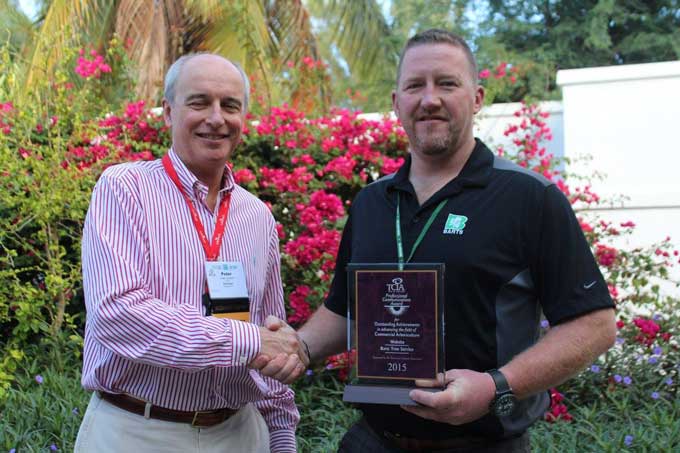
Barts Tree Service is a member of the Arbor Day Foundation and you should be as well.
They help promote tree pruning and tree removal best practices across the industry as well as educate people on the correct trees to plant for the Connecticut region and there specific application. Unfortunately this is all too often why Barts Tree Service is called out to remove a hazardous tree that’s in perfectly good health. It’s just the wrong tree in the wrong location and over the years has grown to close to a dwelling or is far too large to be safe in its current location.
It’s as little as $10 and new members will receive 10 trees of there choice. You can’t go wrong for that!
Your contribution/membership to the Arbor Day Foundation will go to:
- Replanting our national forests
- Rain Forest Rescue
- Arboriculture best practices
- Community improvements
- Education
Members will receive The Tree Book, with planting and care information, Arbor Day bimonthly newsletter, membership card, and discounts on more than 100 varieties of trees. New members will also receive 10 free trees specific to their region.
Go visit www.arborday.org
Barts Tree Service on Facebook
Barts Tree Service is now on Facebook so come check us out. Bart’s Tree Service on Facebook
I try to add updates and pictures for some of our current stump grinding, tree removal, tree climbing and stone work projects for all to see.
Hope to see you soon.
What’s killing our ash trees
The suspected killer is called ”ash yellows,” and is increasingly thought to be at work in the majority of cases of decline that have struck white ash trees.
Once an ash has ash yellows, there’s no way to cure it. Instead of living to 100 years or more, white ashes – valued for their fast growth and used to produce baseball bats and hardwood floors and furniture – seem to die within 10 years.
Decline among ash trees, which along with oaks, maples, beeches and birches are commonly found in Connecticut and throughout the Northeast, is not a new phenomenon. Scientists first noticed it in the 1930’s and believe that ”ash dieback” has progressively spread throughout the northeastern states and parts of eastern Canada. It’s progressively getting worse and unlike cases where trees can be sprayed to ward off more common fungus-related diseases, spraying an ash tree to prevent ash yellows is futile.
For decades drought conditions and various viral conditions were thought to be at work in ash decline, but research has settled on another culprit with the ungainly name of mycoplasmalike organism, or MLO. Simply put, MLOs are single-celled bodies that resemble amoebas and invade the food-conducting tubes of trees. With ash yellows, they eventually produce a variety of nasty symptoms: clumps of twigs known as witches’-brooms, stunted branches with leaf bunches at the ends, sprouts on trunks and the discoloration of the green leaves that gives the disease its name. The organisms are believed to be passed from tree to tree by leafhoppers – insects that suck material from one plant and then pass it to another.
One clue to the origins of ash yellows may come from studying peach trees in our area, which have been dying for years from something called x-disease, also thought to be caused by an MLO. Nobody knows whether it’s all the same or each one is genetically different at this time.
Although injecting antibiotics into other trees suffering from MLO-related diseases has temporarily halted decline, even if the right substance could be found it would be impractical since it would have to administered year after year. Because there is little chance of prevention, it is thought that the best hope for halting the spread of ash yellows is identifying genetically resistant trees and then propagating them.
Between Ash Yellows (MLO) and the Emerald Ash Borer (EAB) the ash tree has a very bleak future ahead.
If you notice your ash tree suffering from “ash yellows” and you are seeing a steady decline in foliage you only have a 1-3 year window generally for when the tree will die. I would recommend removing the tree prior to it dying since it is structurally safer to work with and will save money versus taking down a completely dead tree.
For further information on Emerald Ash Borer (EAB) click here to see my other posting.